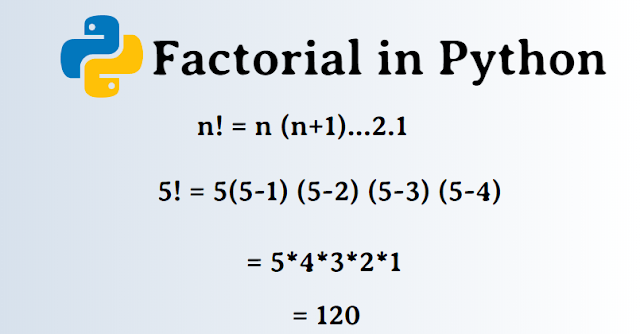
Factorial Program in Python

Factorial Program  in python


What is Factorial Program?

Factorial Program in C: Factorial of n is the product of all positive descending integers. Factorial of n is denoted by n!. For example: 5! = 5*4*3*2*1 = 120.

How do you code a factorial for a loop in Python?

  1. num = int(input("enter a number: "))
  2. fac = 1.
  3. for i in range(1, num + 1):
  4. fac = fac * i.
  5. print("factorial of ", num, " is ", fac)

Factorial Program in Python

# Python program to find the factorial of a number provided by the user.

# change the value for a different result
num = 7

# To take input from the user
#num = int(input("Enter a number: "))

factorial = 1

# check if the number is negative, positive or zero
if num < 0:
   print("Sorry, factorial does not exist for negative numbers")
elif num == 0:
   print("The factorial of 0 is 1")
else:
   for i in range(1,num + 1):
       factorial = factorial*i
   print("The factorial of",num,"is",factorial)

Comments

Popular posts from this blog

Writing first python program

  We are here to write our first program,it will  be an easy program just printing the entered word or value. The syntax of python language is very simple and easy and you dont have to confuse your mind with any complexity. So here is our first program print ( "Hello my name is abc" ) print command is used to display the output written in brackets with inverted commas. As we have typed the sentence "Hello my name is abc". So this command will simply print this sentence as show above in the picture.  

Conditional Statements

Conditional STATEMENTS Normally, the statements are executed sequentially as written in the program (i.e. Top to bottom). This is known as the normal flow of control. But sometimes the operational flow of control has to be altered depending upon a condition. The statements that allow to do so, are known as selection statements. Most important selection statement that python offers is the If statement. Selection statements are also known as conditional statements or decision statements. THE IF STATEMENT An if statement tests a particular condition; if the condition evaluates to true, a course of action is followed i.e. a statement of a set of statements is executed. If the condition is false the course of action is ignored. The syntax of if statement is as shown below: if (expression) : Statement THE ELIF STATEMENT In some cases the program requires you to write multiple if statements. This results in many condition evaluations thus slowing up the program. So to avoid th...

Loop Statements

Loop STATEMENTS The Loop statements allow a set of instructions to be performed repeatedly until a certain condition is fulfilled. The iteration statements are also called loops or looping statements. THE FOR LOOP The for loop is the easiest to understand of the python loops. Syntax: For I in range(lowerlimit,upperlimit): Loop Body The program will run until I value becomes equal to upperlimit – 1. Example: For I in range(1,5): Print(“Hello”) This program will print Hello 4 times, ie from 1 to 4 (upper limit-1)  I value will start as 1 then loop body will get executed and I value will be incremented. This keeps on taking place until I ==upper limit-1 . After that the program comes out of loop body. THE WHILE LOOP The second loop available in python is the while loop. The while loop is an entry controlled loop. The syntax of a while loop is while (expression): Loop-body Where loop body keep on getting executed until the expression becomes false. When the expression becomes false, th...